When will my next period start?
Add your usual cycle length to the first day of your most recent period. The result is an estimate; timing can vary.
YOUR CYCLE, AT A GLANCE
Estimate your next period, ovulation date and fertile window. Free, private and easy to use.
Estimates, not certainties. Ovulation can vary even with regular cycles. This calculator cannot diagnose a condition or reliably prevent pregnancy.
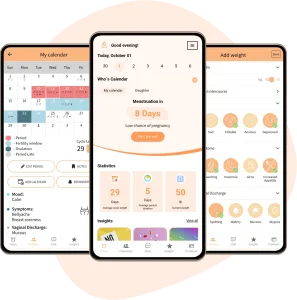
Your web calculation gives you an estimate. Selin helps you track cycles over time, log symptoms, set reminders and see future predictions. These web dates are not transferred to the app.
Add your usual cycle length to the first day of your most recent period. The result is an estimate; timing can vary.
This tool models ovulation 14 days before the next estimated period. It cannot confirm the exact day.
Days around ovulation when conception may be possible. The marked dates are approximate and do not identify safe days.
No. It projects dates from the values you enter; it does not measure future menstruation or ovulation.
Choose your most recent start and your usual cycle and period lengths.
Explore your next period, approximate ovulation and a 3, 6 or 12-month calendar.
Use the app for an ongoing history, symptoms and reminders. Web entries are not transferred.
Most recent period start + average cycle length = estimated next start.
Estimated start + period length − 1 day = estimated final bleeding day.
Estimated next start − 14 days = modeled ovulation date.
Modeled ovulation − 5 days through + 1 day. These are estimates, not measurements or a diagnosis.
NHS — Menstrual cycles and fertility
Estimates, not certainties. Ovulation can vary even with regular cycles. This calculator cannot diagnose a condition or reliably prevent pregnancy.
A cycle starts on the first day of a period and ends the day before the next one. Hormones influence ovulation and changes in the womb lining. The bleeding days are only one part of the cycle; cycle length counts the whole interval between period starts.
NHS guidance describes regular adult cycles of 21–35 days and bleeding of about 2–7 days. These are general patterns, not a diagnosis. Your age, contraception and life stage matter. This calculator accepts a wider input range so it can flag unusual values without deciding what is healthy for you.
28 days is a common reference, not a target. Timing can differ between people and between cycles. Replace the example input with your usual length. Longer forecasts repeat that same length; they cannot anticipate a future change in your pattern.
Pregnancy, stress, weight changes, hormonal contraception and life-stage changes can affect timing. A calendar cannot identify the cause of a late period. If pregnancy is possible, use a pregnancy test rather than treating a prediction as an answer.
The tool subtracts 14 days from the estimated next period. This is a modeling assumption, not evidence that an egg was released. Ovulation can occur at a different time even in regular cycles. Calendar dates do not measure hormones or other signs of ovulation.
It describes the days around ovulation when conception may be possible. The shaded window uses five days before the modeled ovulation date through one day afterward. It is an illustration, not a boundary: actual fertile days may fall outside it, and unmarked days are not “safe” days.
A single typical cycle length may describe an irregular pattern poorly. The tool can still illustrate dates, but those dates may be less useful for planning. Keep a record of actual starts in your own diary or app and discuss changes with a healthcare professional rather than repeatedly adjusting a prediction.
It is a planning aid, with no validated individual accuracy percentage. It uses the three values you enter and repeats the same cycle length. It cannot know whether your next cycle will be shorter or longer, and uncertainty grows further into the future.
No. Do not rely on this calendar to avoid pregnancy. Fertility-awareness methods require more than this calculation and appropriate instruction; they may not suit everyone. Ask a qualified healthcare professional about contraceptive options that fit your needs.
Seek advice if your usual pattern changes, periods are irregular, bleeding lasts more than seven days, or symptoms concern you. Bleeding between periods or after sex also needs assessment. A calculator cannot explain these changes or replace a clinical consultation.
NHS — Periods and cycle patterns · Irregular periods and when to seek advice
Practical answers about your dates, cycle changes and privacy. Open a question to learn more.
Enter the first day of your most recent period, then your usual cycle and period lengths. Select Calculate my cycle to see your estimate.
Count the days between actual period starts over several cycles and work out your usual interval. The default 28 is only an example, not a personalized estimate. For example, intervals of 27, 29 and 28 days average 28 days. Count from the first day of one period to the first day of the next, not the number of bleeding days.
There are several possible reasons, including pregnancy and changes in stress or hormones. A calendar cannot determine the cause. Consider a pregnancy test if pregnancy is possible.
NHS — Missed or late periodsYes. That is why repeating one average into the future gives estimates rather than appointments your body must keep.
NHS — Irregular periods and when to seek adviceTreat the calendar cautiously. Record actual starts and speak with a healthcare professional about irregularity or a change in your usual pattern.
NHS — Irregular periods and when to seek adviceIts usefulness depends on how closely future cycles follow the entered length. This calculator has no established individual accuracy percentage. The 6- and 12-month views repeat the same cycle length; they are not more certain forecasts. Update your last start date when your next period begins.
No. The calendar does not identify reliably safe days and is not a contraceptive method.
NHS — Fertility awareness and contraceptionThe web tool keeps them only in isolated browser memory and clears them on reload. App-store buttons do not save or transfer the dates.
Gynecologist and sexologist, Selin
Reviewed:
Build your ongoing cycle history with Selin. Keep periods, symptoms and reminders together, at your own pace.


