When am I likely to ovulate?
The calculator places ovulation about 14 days before your next estimated period. Your actual timing may differ.
YOUR FERTILE WINDOW, AT A GLANCE
Estimate when you may ovulate and see your likely fertile window using your last period and usual cycle length.
Estimates, not certainties. Ovulation can vary even with regular cycles. This calculator cannot diagnose a condition or reliably prevent pregnancy.
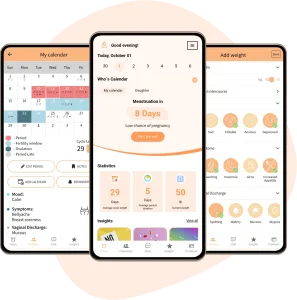
Your web calculation gives you an estimate. Selin helps you track cycles over time, log symptoms, set reminders and see future predictions. These web dates are not transferred to the app.
The calculator places ovulation about 14 days before your next estimated period. Your actual timing may differ.
The days around ovulation when conception may be possible. Our displayed dates are planning estimates, not confirmed fertile days.
Yes, even with regular cycles. An average cannot anticipate every change.
No. Calendar arithmetic cannot confirm egg release.
Choose your last period’s first day and usual cycle length. No account is needed.
Read your estimated ovulation date, timeline and three-cycle forecast.
Selin helps track cycles, symptoms and reminders. Web dates are not transferred.
Last period start + usual cycle length.
Next estimated period − 14 days. This is an assumption, not evidence of ovulation.
Estimated ovulation − 5 days through + 1 day. The extra day is a planning margin, not proof of fertility.
The interval from ovulation to a period varies. Repeating a fixed length cannot measure that variation.
NHS — Menstrual cycles and fertility
Estimates, not certainties. Ovulation can vary even with regular cycles. This calculator cannot diagnose a condition or reliably prevent pregnancy.
Ovulation is the release of an egg from an ovary. A calendar can suggest timing but cannot establish whether release occurred.
ASRM describes a six-day biological window ending on ovulation day. This tool displays an additional day after the estimated date as a planning margin; it does not define your actual window.
This calculator measures neither LH nor progesterone, temperature or cervical mucus. An LH test detects a hormone rise; by itself, it does not prove egg release.
Regular sex every two to three days can avoid relying on a single predicted date. Choose an approach that suits you; a calendar cannot guarantee pregnancy.
Stress, illness, hormonal changes and life stages may change your pattern. Irregular cycles make a single average less informative.
Clearer, stretchier cervical mucus may occur around ovulation. Symptoms alone cannot establish an exact ovulation date.
No. Actual fertile days can fall outside the displayed range. Ask a healthcare professional about suitable contraception.
Discuss persistently irregular or absent periods, new symptoms or concerns about conceiving with a healthcare professional. The calculator cannot diagnose fertility problems.
NHS — Periods and cycle patterns · Irregular periods and when to seek advice
Practical questions about ovulation, trying to conceive and your privacy.
Enter the first day of your last period and your usual interval between period starts, then select Calculate ovulation.
The tool adds 28 days to the entered start and subtracts 14. For a 1 September start, that gives 15 September. It is not a universal cycle-day rule.
Count the days between actual period starts over several cycles. The example value 28 is not personalized.
Yes, especially with earlier ovulation or shorter cycles. Bleeding dates do not establish safe days.
NHS — Menstrual cycles and fertilityYes. A later ovulation can shift the fertile window and the next period beyond a calendar estimate.
NHS — Menstrual cycles and fertilityThere is no validated individual accuracy percentage. Future cycles may differ from the usual length you enter.
This natural-cycle model may not apply. Withdrawal bleeding does not necessarily indicate an ovulatory cycle.
Yes. Actual ovulation may differ from the estimate, so unmarked dates are not a reliable boundary.
No. This calculator is not a contraceptive method.
NHS — Fertility awareness and contraceptionNo. These web entries remain in isolated browser memory. Store buttons and sharing links contain no health values.
Gynecologist and sexologist, Selin
Reviewed:
Build your ongoing cycle history with Selin. Keep periods, symptoms and reminders together, at your own pace.


